



Key takeaways
- Wi-Fi 8 focuses on reliability, mobility and predictable performance rather than a new peak-speed headline.
- SMD, Multi-AP Coordination, DSO and ELR address distinct roaming, density, spectrum and range problems.
- Product teams can prototype early while tracking the draft revision and interoperability path.
What Is Wi-Fi 8? A Practical Guide for Product Developers
If you’re speccing a router, gateway, or edge device roadmap for 2027-2028, “Wi-Fi 8” has probably already landed in a requirements doc somewhere — usually with no more detail than the name itself. Here’s what the standard actually is, what’s still moving, and what it means if you’re the one who has to put it on a board.
Wi-Fi 8: Designed for Reliable Connections
Wi-Fi 8 builds on IEEE 802.11bn, named Ultra High Reliability (UHR). It targets more predictable connections in dense networks, interference and moving-client deployments. Peak throughput remains broadly in Wi-Fi 7 territory, while the development focus is continuity and reliability under real operating conditions.
This direction helps product teams planning high-density access points, warehouse networks and mobile industrial systems. Use the application’s client count, traffic profile and mobility requirements to select the platform.
The four features actually worth designing around
Strip away the marketing layer and 802.11bn comes down to four mechanisms:
- Single Mobility Domain (SMD) — lets a station stay associated while moving between APs inside the same domain, instead of doing a full re-association each time. This is the direct answer to multi-AP roaming latency and packet loss — the exact failure mode that shows up as “the robot’s connection blips every time it crosses a cell boundary.”
- Multi-AP Coordination (MAPC): APs coordinate channel access and spectrum use, supporting reliability in facilities with high AP density.
- Dynamic Subband Operation (DSO) — lets an AP hand a client a slice of bandwidth outside that client’s normal operating range when there’s a capability mismatch, instead of falling back to the lowest common denominator.
- Enhanced Long Range (ELR) — addresses the link-budget imbalance between AP and station, with defined support for uplink transmission on 2.4/5/6 GHz and downlink on 2.4 GHz. Relevant to anything using a low-power, small-antenna client at range — a drone, a sensor node, a handheld.
None of these are throughput features. All four are reliability-under-real-conditions features, which is a different design conversation than the one Wi-Fi 6→7 required.
Where the standard actually stands (be honest about this)
IEEE 802.11bn is in draft development. The first D1.0 draft was released in mid-2025; the roadmap described here anticipates sponsor ballot around 2027 and final ratification in 2028. Pre-standard silicon gives engineering teams a basis for early hardware and integration work.
For pre-standard Wi-Fi 8 platforms, match the chipset’s draft revision, firmware and interoperability plan to the project schedule. Qualification with the intended clients and access points is part of production integration.
What we’re actually doing about it
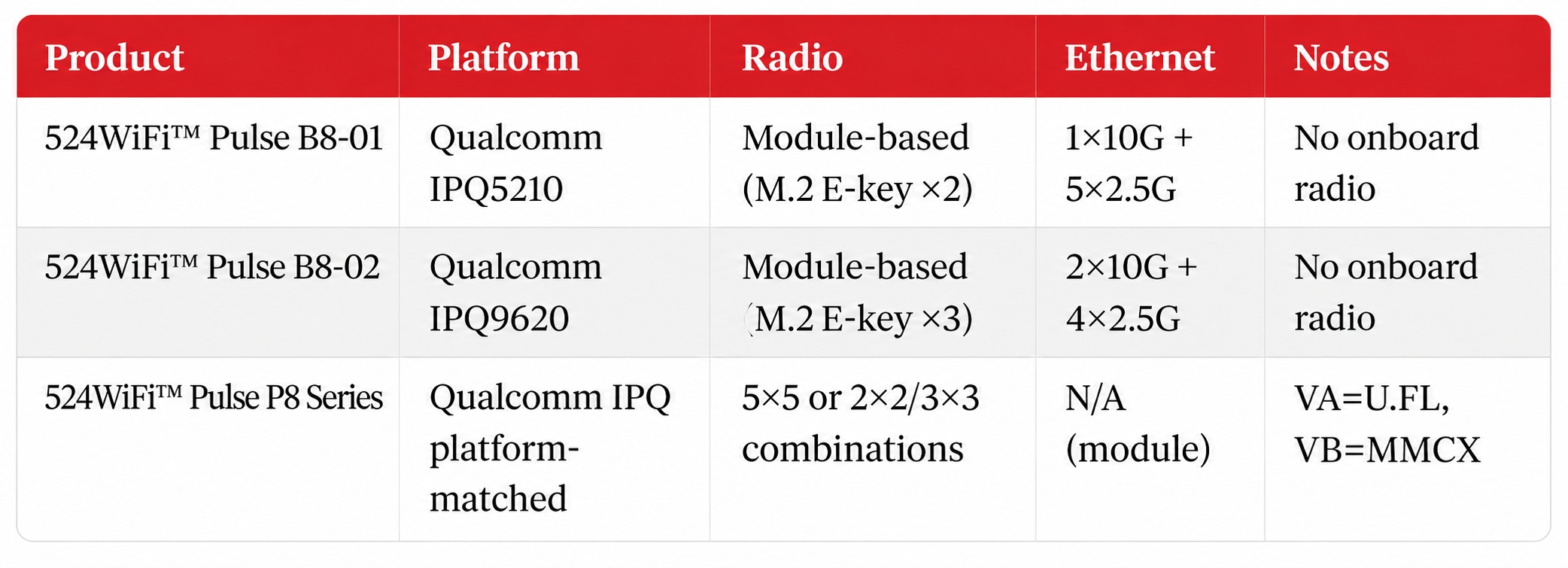
Our Qualcomm-based Wi-Fi 8 reference-design work supports early assessment of board-level integration for SMD, MAPC, DSO and ELR capabilities. This provides a foundation for RF, firmware and product architecture planning.
A few things stand out working with early boards like this one:
(Figure 1 — reference board, RF/SoC section) The RF and processing cluster on this design sits in a dedicated shielded zone with the SoC and its companion radio ICs laid out for short, controlled trace lengths — coordination features like MAPC put more demand on tight timing between radio paths than a standalone AP design ever did.
(Figure 2 — reference board, underside) The support circuitry — power sequencing, clocking — is denser than what we’re used to on a Wi-Fi 6/7 board of similar size, which tracks with a chipset doing more real-time coordination work rather than just more raw PHY throughput.
What this means if you’re planning a 2027 product
- Start prototyping early. Use pre-standard silicon to build firmware and RF integration experience alongside the standard’s development.
- Match the feature to the actual problem. SMD solves roaming, MAPC solves density, ELR solves range, DSO solves capability mismatches. Pick the one that maps to your customer’s actual failure mode rather than treating “Wi-Fi 8” as one undifferentiated upgrade.
- Confirm the targeted draft revision. Match the chipset implementation, firmware and qualification plan to your product roadmap.
If you’re evaluating a Qualcomm-based Wi-Fi 8 platform for your own product — whether that’s a carrier board, an ODM hardware partnership, or just a technical sounding board while the standard finishes settling — we’re happy to compare