

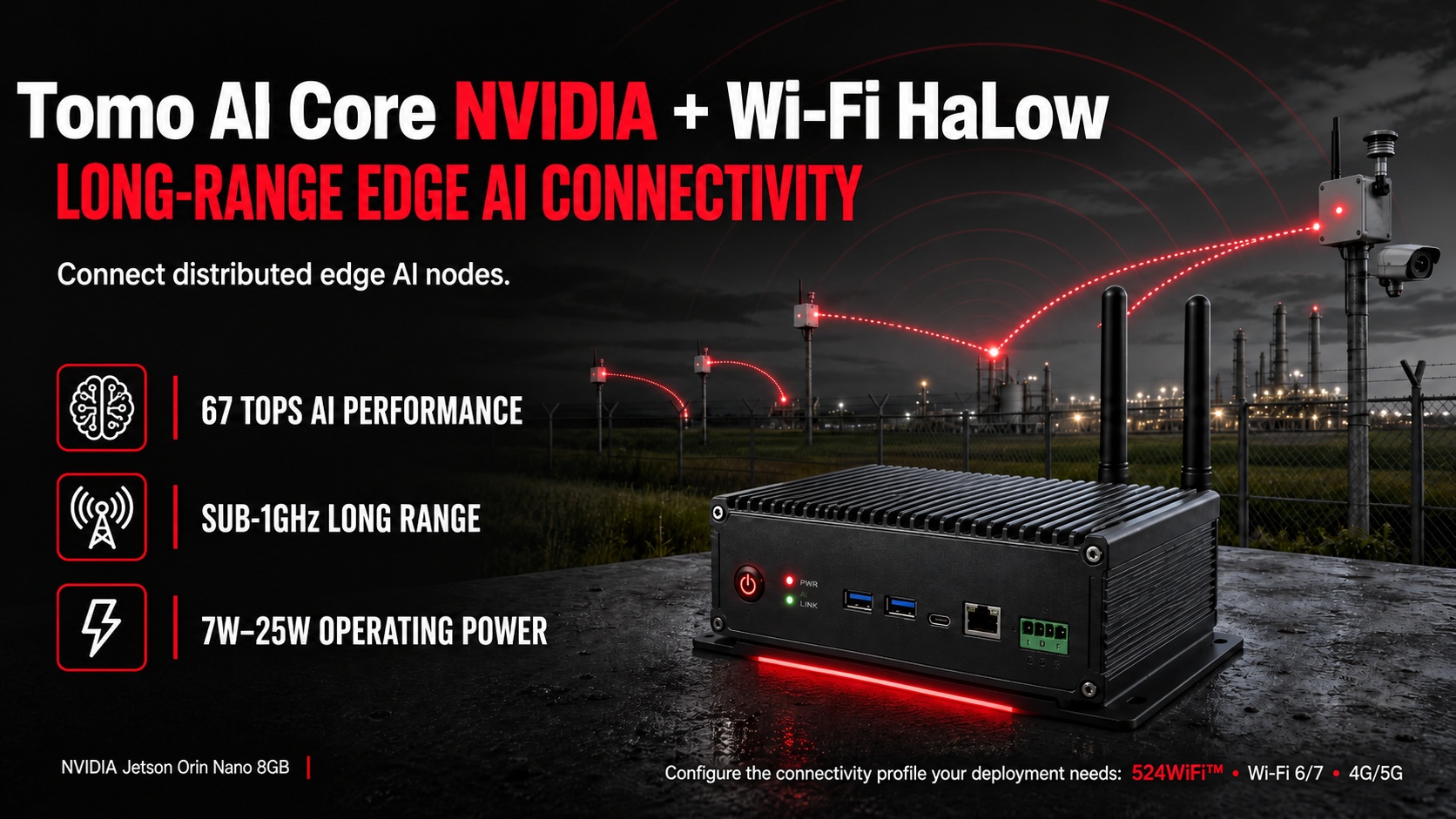
Tomo AI Core NVIDIA connects local AI processing with the network your deployment needs. Wi-Fi HaLow (IEEE 802.11ah) adds a long-range, low-power connectivity option to this NVIDIA Jetson Orin Nano-based edge AI platform, helping outdoor and distributed nodes send detection results and telemetry to the control system.
What Is Wi-Fi HaLow and Why Does Edge AI Need It?
Wi-Fi HaLow operates in the sub-1GHz spectrum (900MHz ISM band in most regions) instead of the 2.4GHz/5GHz bands used by conventional Wi-Fi. Lower frequency signals travel farther and penetrate walls, foliage, and structural obstacles far more effectively — which is exactly why HaLow is positioned by the Wi-Fi Alliance for long-range, low-power IoT and sensor connectivity rather than high-bandwidth video streaming.
For edge AI deployments, HaLow is well suited to sending detection results, telemetry and compressed metadata from distributed Jetson-based nodes to a gateway. Its range and power profile supports planning for battery- or solar-powered installations across outdoor sites.
How Wi-Fi HaLow Connects with the Tomo AI Core NVIDIA AI Box
The AI Box (Tomo AI Core NVIDIA) pairs an NVIDIA Jetson Orin Nano 8GB SOM (67 TOPS AI performance, 1024-core Ampere GPU, 6-core Arm Cortex-A78AE CPU) with a 524WiFi™ custom carrier board built for industrial edge deployment — 5x Ethernet (including PoE), CAN FD, RS485, GPIO, and M.2 PCIe NVMe expansion.
Wi-Fi HaLow is integrated as a module option on that same carrier board, alongside the existing 2.4G/5.8G Wi-Fi and optional 4G/5G cellular paths. In practice this means a single AI Box can be configured for the connectivity profile the deployment actually needs: short-range high-bandwidth Wi-Fi for a warehouse, cellular for a mobile asset, or HaLow for a long-range, low-power sensor or camera node spread across an outdoor site.
Wi-Fi HaLow vs. Traditional Wi-Fi for Long-Range Edge AI
The two technologies solve different problems rather than competing head-to-head.
Range: traditional 2.4/5GHz Wi-Fi typically covers tens of meters indoors; Wi-Fi HaLow's 900MHz band extends to hundreds of meters, up to roughly 1km line-of-sight.
Obstacle penetration: traditional Wi-Fi signal degrades quickly through walls and foliage; HaLow's lower frequency travels through obstacles more effectively.
Power consumption: traditional Wi-Fi draws more power, which is fine for mains-powered devices; HaLow's lower power draw suits battery- or solar-powered nodes that need to run for months between service visits.
Throughput: Wi-Fi 6/7 provides multi-Gbps-class connectivity for high-bandwidth video applications. HaLow prioritizes range and power efficiency for sensor telemetry, detection results and compressed metadata.
Best fit: traditional Wi-Fi suits dense, high-bandwidth environments like a multi-camera inspection line; HaLow suits long-range, low-power, distributed nodes like an outdoor perimeter or a field spread across acres.
Tomo AI Core NVIDIA offers configurable connectivity for different deployments: Wi-Fi 6/7 for high-bandwidth multi-camera inspection and HaLow for distributed perimeter sensors, farms and ports.
Edge AI Applications Enabled by Wi-Fi HaLow
- Agriculture: Jetson-based cameras or sensor nodes spread across large fields, sending detection or telemetry data back to a central gateway without running cable or relying on cellular coverage.
- Perimeter and outdoor security: distributed detection nodes in ports, campuses and industrial yards, with long-range connectivity for alerts and telemetry.
- Logistics and asset tracking: distributed sensor nodes across a yard or warehouse exterior, where battery life matters more than throughput.
- Smart infrastructure: environmental or condition-monitoring sensors feeding low-power edge AI nodes over long distances.
Tomo AI Core NVIDIA + Wi-Fi HaLow: Hardware Summary
- Compute: NVIDIA Jetson Orin Nano 8GB SOM (part of the Jetson Nano/Orin Nano product family), 67 TOPS AI performance, 1024-core Ampere GPU with 32 tensor cores, 6-core Arm Cortex-A78AE CPU, 8GB 128-bit LPDDR5
- Connectivity options: Wi-Fi HaLow (long-range, sub-1GHz), onboard 2.4G/5.8G Wi-Fi, optional 4G/5G (Nano SIM), 5x Ethernet (1x independent PoE 48V RJ45 + 4x shared RJ45)
- Interfaces: CAN FD, RS485, RS232, 4x USB 3.0, USB-OTG, 4x GPIO, HDMI 2.0, M.2 PCIe NVMe 2280
- Power: 7W–25W operating range
If you're evaluating long-range or low-power connectivity for a Jetson-based edge AI deployment, we're happy to talk through whether Wi-Fi HaLow, industrial Wi-Fi 6/7, or a hybrid configuration fits your use case. Reach us at info at 524WiFi.net™ or .com
DR Cube