

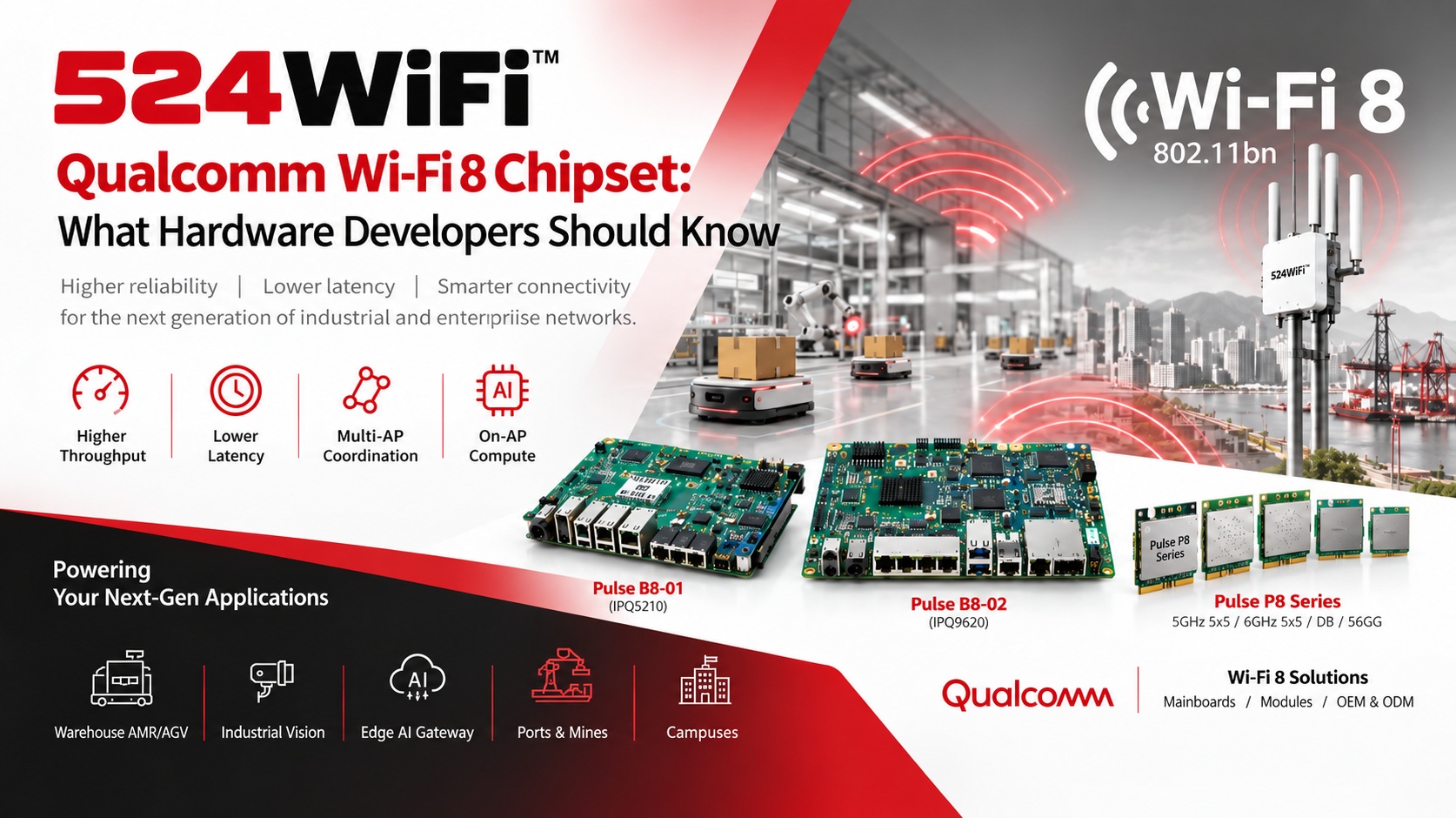
Wi-Fi 8 (IEEE 802.11bn) has moved from a standards discussion into silicon you can design around. Qualcomm's MWC 2026 launch gave hardware teams a concrete platform to plan against. Here is what matters for developers building routers, industrial APs, gateways and robot connectivity.
What Is Qualcomm's Wi-Fi 8 Platform, and Why Does It Matter?
Qualcomm launched a Wi-Fi 8 portfolio with a mobile chip (FastConnect 8800) and new Dragonwing networking platforms aimed at broadband gateways, enterprise access points and fixed wireless equipment. The infrastructure flagship is the Dragonwing NPro A8 Elite, part of the IPQ96 family.
The headline specs from Qualcomm's materials:
- A 5x5 Wi-Fi 8 radio system, with up to 40% more throughput at typical distances, 2.5x lower latency at peak usage, and up to 30% lower daily energy use than the previous generation
- A penta-core CPU up to 2.0 GHz, a Hexagon NPU, and a peak PHY rate of up to 33 Gbps qualcomm
- Capacity for up to 1,500 clients in infrastructure gear
The Wi-Fi 8 design goal is reliability under load. For hardware developers, latency consistency, roaming behavior and performance in dense networks are central benefits. The published 33 Gbps figure describes peak PHY capability; application throughput follows the complete deployment configuration.
How Does Wi-Fi 8 Change Hardware Design?
1. Compute moves onto the access point. The NPro A8 Elite integrates an NPU and a packet processing engine. Your AP can run containerized services and network-optimization models locally instead of relying on a controller or the cloud.
2. Plan high-capacity uplinks. Match the radio architecture with 2.5G and 10G copper or SFP interfaces and the appropriate PoE budget. Qualcomm IPQ96 documentation lists 2.5GbE and 25GbE-class interfaces, making power, thermal and switch design part of the platform plan.
3. Design for 6 GHz. Wide channels and multi-radio architectures benefit from coordinated antenna layout, RF shielding and connector selection, including U.FL and MMCX.
4. Roaming changes. Wi-Fi 8's multi-AP coordination features, including the Single Mobility Domain (SMD) concept for seamless roaming without repeated re-authentication, target moving clients such as AMRs. Client-side support will be the limiting factor early on, so validate with real client devices.
Wi-Fi 8 vs. Wi-Fi 7: What Is Actually Different?

Should you skip Wi-Fi 7? No. Wi-Fi 7 platforms such as IPQ9574 and IPQ5424 are shipping and stable, with mature software. Wi-Fi 8 makes sense when your product roadmap spans 2027 and beyond, or when roaming and latency in dense multi-robot environments are your main pain points.
Which Applications Benefit Most?
- Warehouse AMR/AGV fleets: consistent latency and better roaming matter more than raw Gbps.
- Industrial vision: multi-camera streams need stable uplinks and predictable performance under load.
- Edge AI gateways: on-AP compute can pre-process data before it reaches an edge server.
- Ports, mines and campuses: dense clients, mobile endpoints and harsh RF environments.
Where 524WiFi™ Fits: Wi-Fi 8 Hardware in Development
We are preparing Wi-Fi 8 routerboards and modules built on Qualcomm silicon. A prototype routerboard is currently in production. The planned lineup:
Mainboards with modular radios added through M.2 E-key:
- 524WiFi™ Pulse B8-01 (IPQ5210): DDR4, NOR + NAND, 2× M.2 E-key, 1× 10G copper, 5× 2.5G, 12V
- 524WiFi™ Pulse B8-02 (IPQ9620): DDR4, NOR + NAND, 3× M.2 E-key, 2× 10G copper, 4× 2.5G, 12V
524WiFi™ Pulse P8 Wi-Fi 8 modules:
- 5 GHz 5x5
- 6 GHz 5x5
- DB: 2x2 2.4 GHz + 3x3 5 GHz
- 5G6G: 3x3 5 GHz + 2x2 6 GHz (VB only)
Connector options: VA = U.FL, VB = MMCX.
The mainboard-plus-module approach lets OEMs choose their radio configuration and enclosure, indoor or outdoor, without a full board respin. 524WiFi™ also offers OEM/ODM customization on both Qualcomm and NVIDIA platforms, so you can pair Wi-Fi 8 connectivity with a Jetson-based edge compute design.
Quick Checklist for Hardware Teams
- Define whether you need peak throughput or reliability and roaming. The answer decides Wi-Fi 7 vs. Wi-Fi 8.
- Budget for 2.5G/10G uplinks, PoE and thermal headroom.
- Confirm client-device support before promising end-to-end Wi-Fi 8 gains.
- Get regulatory and certification timelines early, as Wi-Fi 8 products are new to test labs.
- Choose a modular architecture so you can upgrade radios without redesigning the mainboard.
Planning a Wi-Fi 8 or Wi-Fi 7 product? Talk to our engineering team about mainboards, modules and custom designs : info at 524WiFi.net™ or .com
DR5210_VA · DR9575 · DR9650_VA