


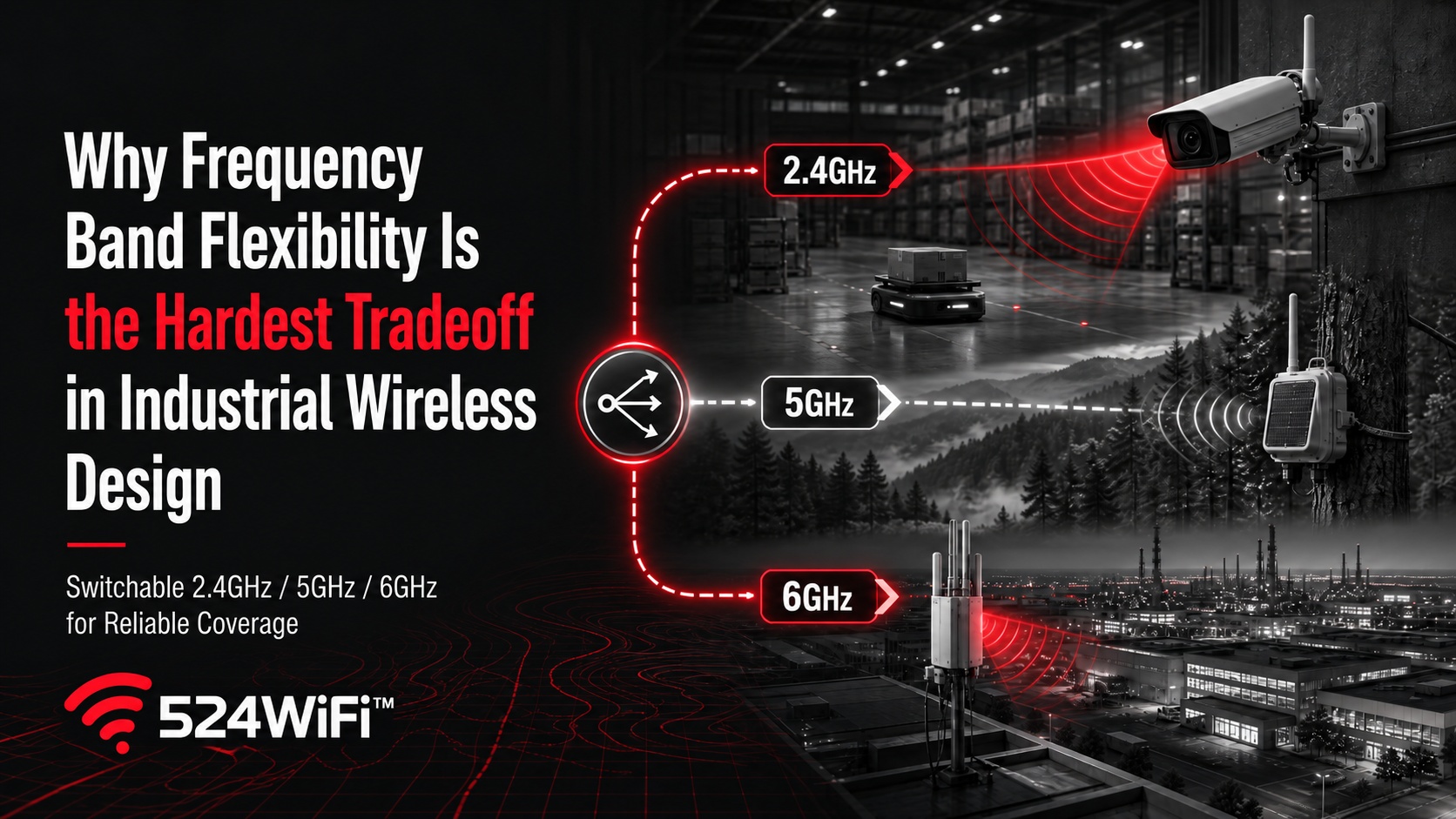
Key takeaways
- Select bands around propagation, interference and capacity requirements.
- A switchable tri-band radio gives integrators one hardware platform that can be tuned to different RF environments.
- Transmit power, MIMO design and the complete antenna chain remain essential to stable coverage.
Reliable wireless starts with the right spectrum and coverage plan. Security cameras, hotels, remote sensors and large facilities benefit from radio architecture selected around the site’s propagation, interference and capacity requirements.
Clean spectrum and stable coverage are central to effective wireless network planning.
- 2.4GHz is congested almost everywhere — too many devices, too much interference, no way around it.
- 5GHz has limited penetration; thick walls, metal structures, and complex terrain all cause fast signal decay.
- Most deployments still run on a single band. When that band gets jammed or congested, there’s no fallback — the system just has to tough it out.
A clear RF path and suitable band selection provide the foundation for stable connections.
Put this principle into concrete scenarios and the conflict becomes obvious:
Security surveillance: HD and AI-driven analytics keep pushing bandwidth requirements higher — a single 4K stream can demand several times the bandwidth of a typical scenario. Yet many installations still connect through consumer-grade routers. Once interference or multiple concurrent streams hit, packet loss and lag become almost inevitable — and unlike video streaming services, surveillance footage has no buffer to absorb the hit, so the stutter happens in real time.
Hotel wireless: plan AP density, placement and band management around room layouts and client demand. Coordinated RF design supports consistent coverage across guest rooms and shared areas.
Forest fire monitoring and remote-area coverage: plan radio paths, power and spectrum around mountainous or forested terrain. A suitable wireless architecture helps connect sensors and warning systems across remote sites.
Large-site and commercial coverage: Whether it’s a campus, an industrial park, or a large commercial venue, the bigger the footprint, the more a single band’s limitations get magnified — signal can be solid in one corner and drop off entirely around the next.
These scenarios look completely different on the surface, but they share the same underlying problem: once the band in use gets “jammed,” the device has no alternate route.
A flexible band-selection strategy gives the network additional operating choices. Assess 2.4, 5 and 6 GHz against congestion, propagation and the intended radio path.
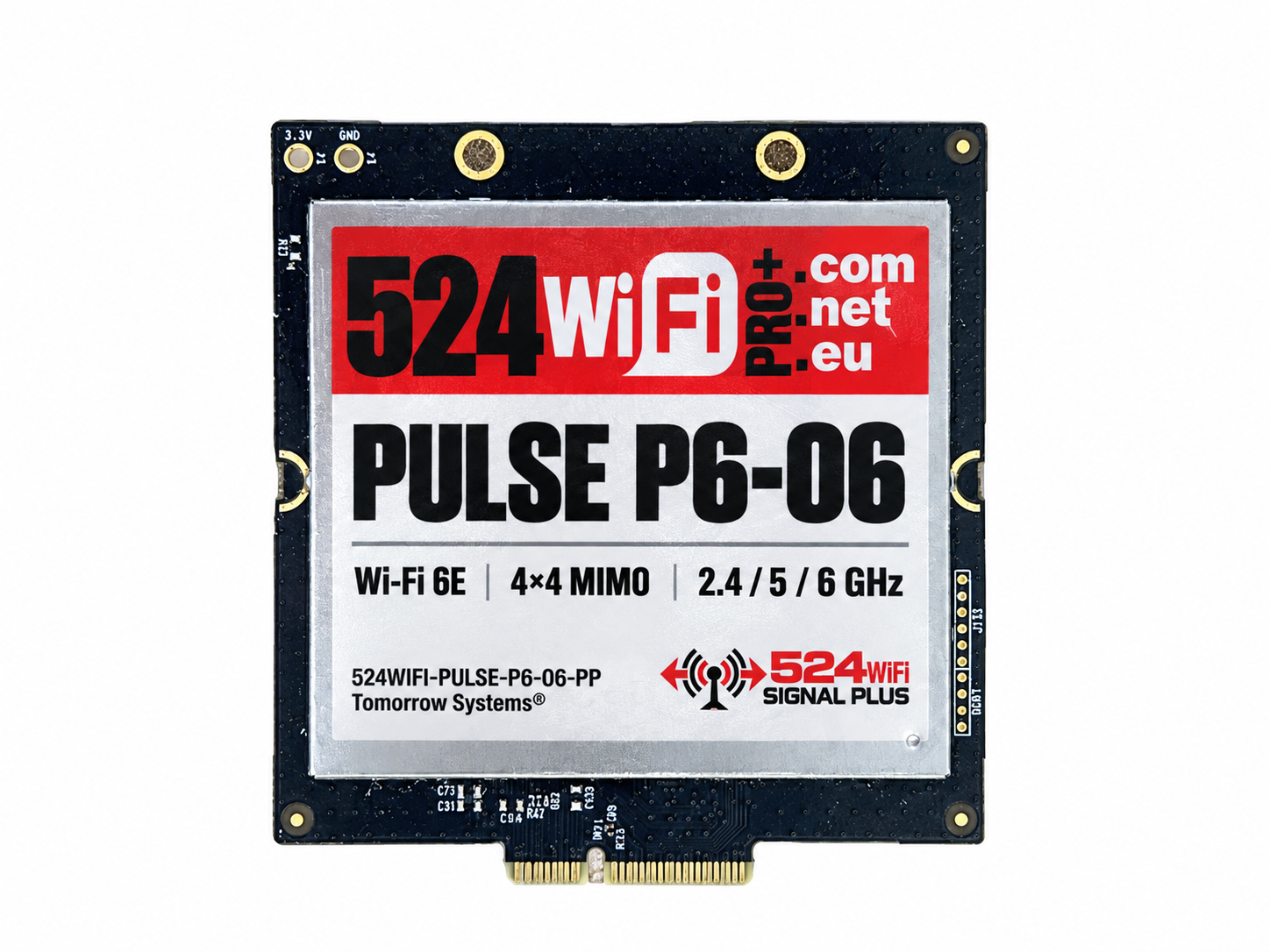
A tri-band switchable card supports selection among 2.4, 5 and 6 GHz operating bands. Configure its radio on the supported band that best fits the site’s RF environment; use a concurrent multi-radio platform when the design calls for simultaneous band operation.
Take 524WiFi™ 6 524WiFi™ Pulse P6-06 as an example — a WiFi 6E (802.11ax) module built on the Qualcomm QCN9024 platform, using an M.2 E Key interface over PCIe 3.0, supporting switchable operation across 2.4GHz/5GHz/6GHz, with a 4T4R (4-spatial-stream) design, up to 23dBm per chain, and a theoretical rate of up to 4949Mbps.
Mapped back to the scenarios above, here’s where that matters in practice:
- Security surveillance: 6GHz is cleaner spectrum — in high-density camera deployments or environments with heavy WiFi interference, switching to it can cut packet loss and lag.
- Hotel wireless: For the classic pain point of dense rooms and congested bands, there’s no need to deploy different band-specific hardware per floor or interference profile — one card switches as needed to cover multiple conditions.
- Forest fire / remote areas: 23dBm transmit power combined with 4T4R spatial streams helps deliver a more stable coverage radius across open or complex terrain.
- Large-site coverage: The ability to switch flexibly across three bands lets deployers tune each area to its actual interference conditions, instead of applying one fixed configuration everywhere.
Wireless network stability was never really about the numbers on a spec sheet — it’s about whether the system can keep finding a usable path in a real, complex, interference-heavy environment. Band-switching capability, transmit power, and multi-stream design all ultimately serve the same goal: keeping the network from failing you when it matters most.
If you’re evaluating wireless solutions for surveillance, hospitality, remote monitoring, or large-site coverage, reach out to talk through the details.
DR9074-Triband