
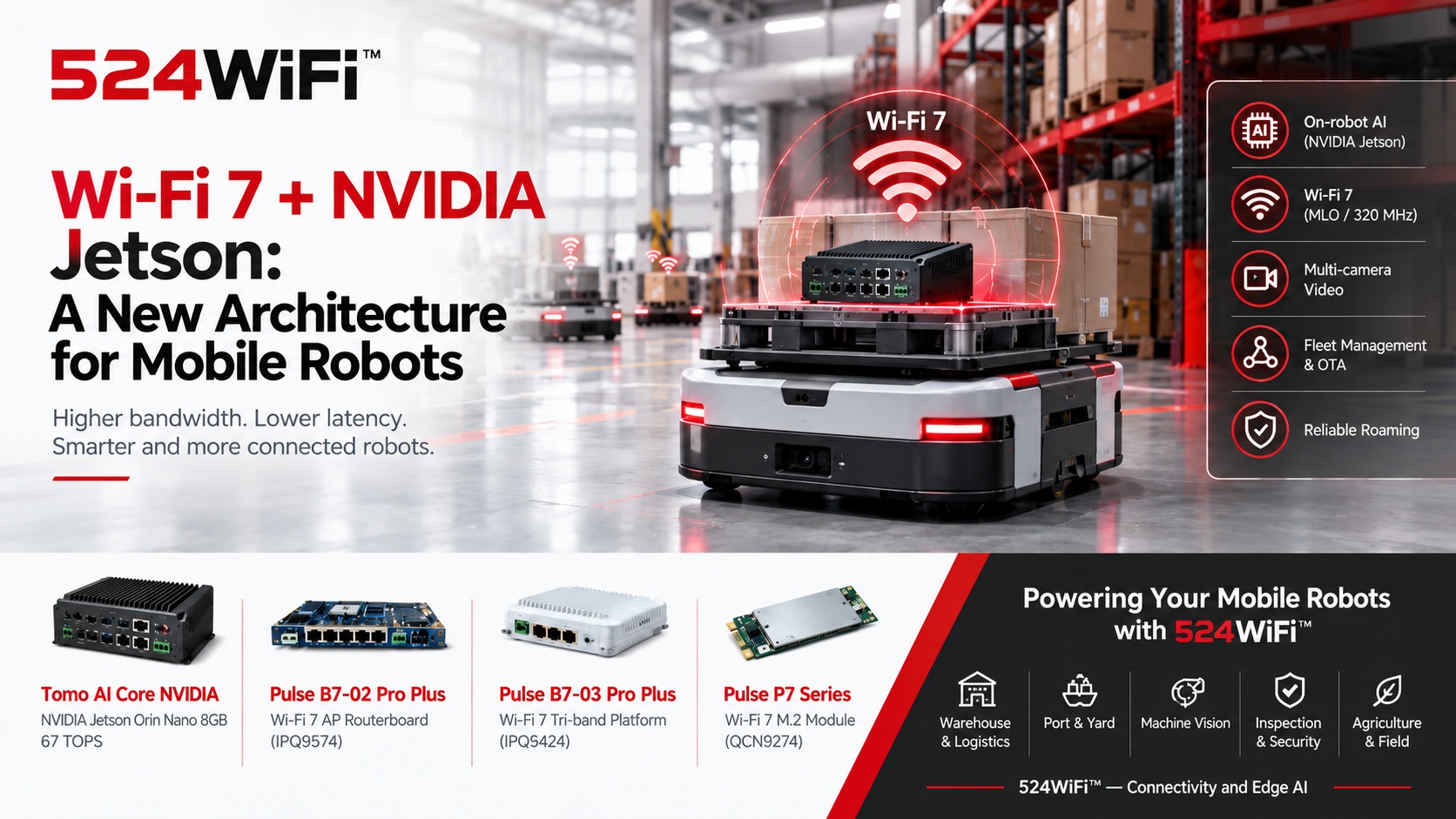
Modern AMRs and UGVs bring cameras, LiDAR, depth sensors and local perception processing together on a moving platform. NVIDIA Jetson provides edge compute on the robot, while Wi-Fi 7 connectivity supports data movement across warehouses, ports and factory floors.
Pair Jetson-class edge compute with Wi-Fi 7 infrastructure as a coordinated architecture for mobile robotics.
Why Jetson and Wi-Fi 7 belong in the same architecture
Jetson runs perception, localization and navigation locally on the robot. The wireless network carries fleet-level data between robots and the wider control system:
- Compressed multi-camera streams for remote monitoring and teleoperation
- Map and model updates pushed to many robots at once
- Fleet telemetry, task dispatch, and OTA firmware
- Handover of the robot's connection between access points while moving
Wi-Fi 7 (IEEE 802.11be) addresses these directly. Channels of up to 320 MHz in the 6 GHz band raise per-link capacity. 4K-QAM raises spectral efficiency. Multi-Link Operation (MLO) lets a client use more than one band to improve reliability and reduce latency variation. Multi-RU scheduling helps when many small clients share a channel, which is the typical multi-robot case.
How the pieces fit together: 524WiFi™ and Tomorrow Systems® edge platform
At 524WiFi™ and Tomorrow Systems®, we treat the robot's compute and its radio as one design problem rather than two separate purchases.
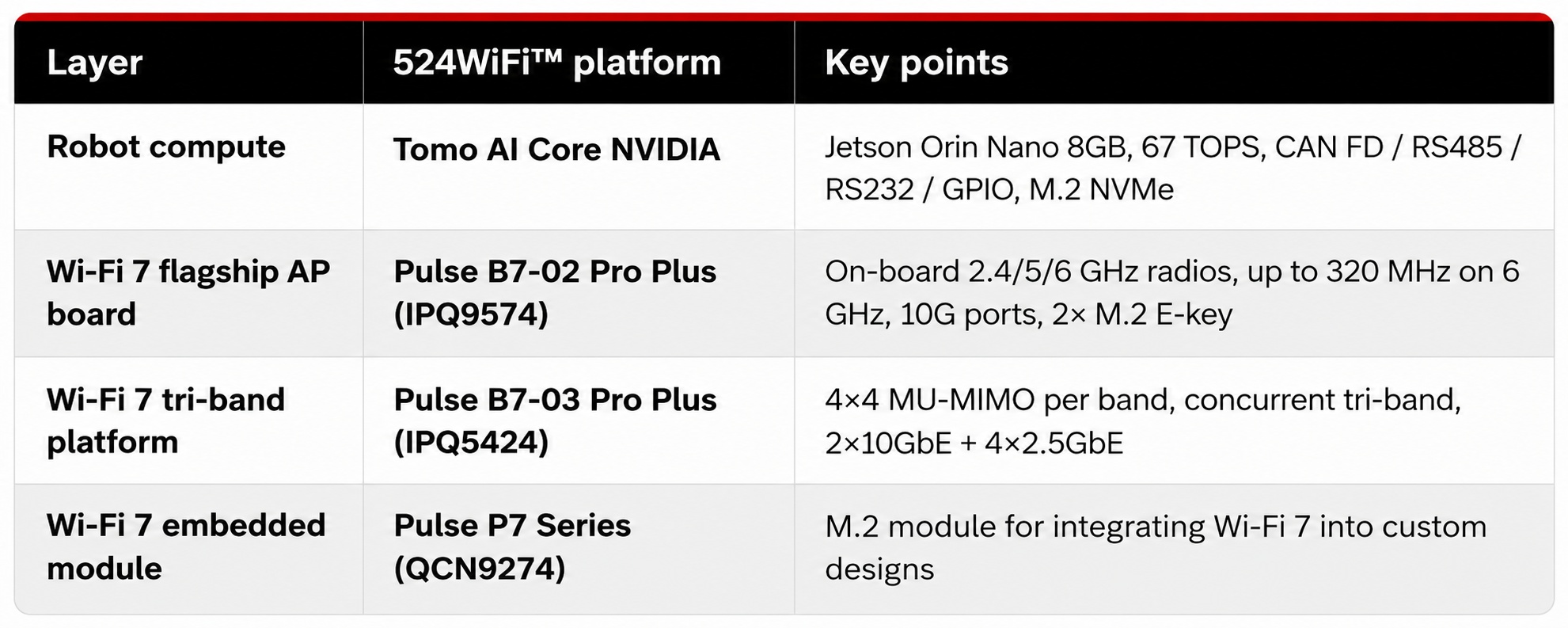
On the robot: the Tomo AI Core NVIDIA AI Box is built on the NVIDIA Jetson Orin Nano 8GB module with our custom carrier board. It offers 67 TOPS of AI performance. Connectivity includes Gigabit Ethernet (one port with 48V PoE), optional Wi-Fi, and optional 4G/5G. Robot-side I/O includes CAN FD, RS485, RS232, GPIO, USB 3.0, and an M.2 NVMe slot. Because we design custom carrier boards, the same architecture can also be built around a different Jetson module or a different I/O layout.
On the infrastructure side: Wi-Fi 7 platforms based on Qualcomm silicon serve as the access point layer. Examples are the 524WiFi™ Pulse B7-02 (IPQ9574), the 524WiFi™ Pulse B7-03 (IPQ5424), and the 524WiFi™ Pulse P7 M.2 module (QCN9274) for embedding Wi-Fi 7 into your own hardware.
Select the radio architecture for the application. Pulse B7-03 and Pulse B7-02 operate independent 2.4, 5 and 6 GHz radio chains concurrently. Tri-band switchable cards select an operating band from the supported band set. Concurrent radios suit parallel traffic across bands; switchable radios provide band-selection flexibility.
Compared with the usual approach
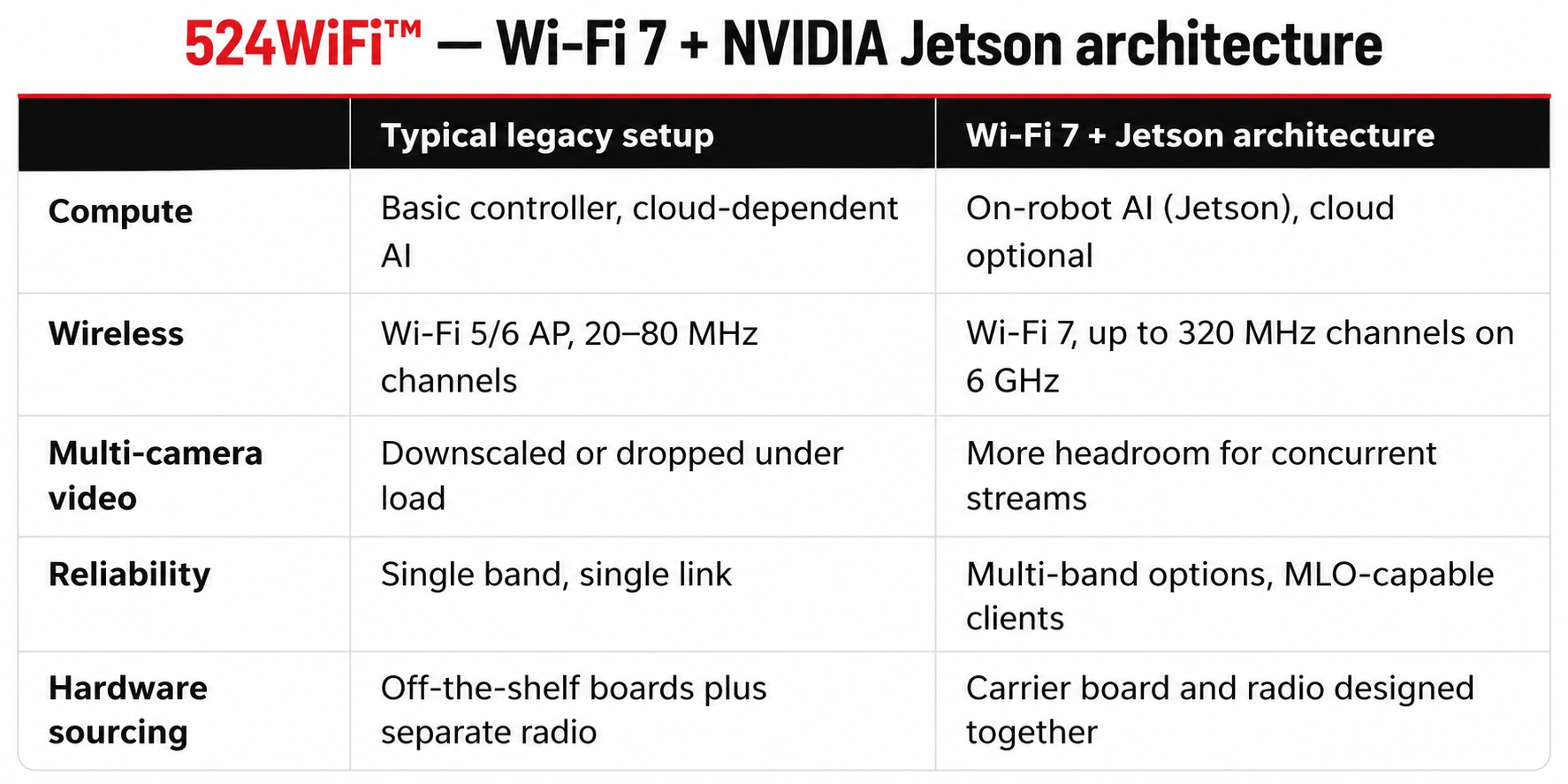
Wi-Fi 7 combines higher-capacity links with multi-band tools for robotics networks. Plan AP placement, channels and compatible clients together to support the intended roaming route and traffic load.
Where this architecture applies
- Warehouse and logistics AMRs: dense multi-robot fleets with steady roaming and continuous telemetry
- Port and yard vehicles: long-range coverage with camera-based monitoring
- Machine vision on the move: multi-camera, high-resolution image transfer to inspection systems
- Inspection and security robots: live video plus on-board detection
- Agricultural and field robotics: long-range control and video links, with custom transmission software where needed
Hardware summary
Talk to us
For mobile robots built on Jetson, 524WiFi™ supplies modules, routerboards and custom carrier-board solutions, with long-range transmission software customization for the project’s connectivity requirements.
DR Cube · DR5424 · DR9274 · DR9574S