

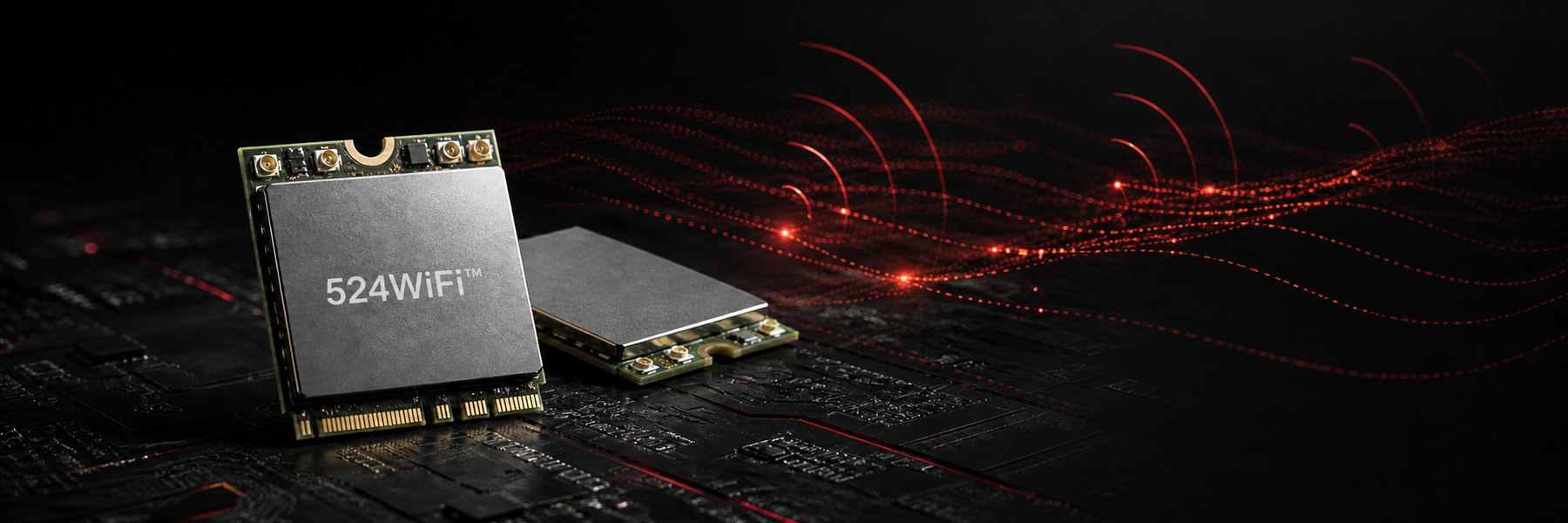
Wi‑Fi 8 has moved beyond specification discussions and into real silicon. Qualcomm Technologies announced the FastConnect 8800 Mobile Connectivity System on 2 March 2026, giving module designers an early view of how the next wireless generation will change radio architecture, antenna planning and product roadmaps.
FastConnect 8800 brings 4×4 Wi‑Fi to mobile connectivity
Qualcomm describes FastConnect 8800 as its first mobile connectivity system with a 4×4 Wi‑Fi radio architecture. The company states a peak PHY rate of up to 11.6 Gbit/s and, in its internal testing, up to three times longer gigabit range than the previous generation. The platform combines Wi‑Fi 8, Bluetooth High Data Throughput, Ultra‑Wideband and Thread in a single 6 nm solution.
For engineers working with compact radio cards, the 4×4 architecture is the most consequential part of the announcement. More spatial streams can improve throughput and link robustness, but they also increase the importance of antenna isolation, connector placement, RF front‑end design, power delivery and thermal management.
What this means for wireless module design
1. Reliability becomes a first‑class design target
Wi‑Fi 7 established multi‑link operation and wider 320 MHz channels. Wi‑Fi 8 is expected to build on that foundation with features focused on ultra‑high reliability, including better performance at the edge of coverage and more consistent operation in congested networks. For industrial, robotics and embedded applications, predictable latency can be more valuable than a laboratory peak-speed number.
2. Antenna design will matter even more
A 4×4 radio cannot deliver its potential without a well‑engineered antenna system. Product teams should plan early for four usable RF paths, adequate spatial separation, coexistence with Bluetooth and UWB, enclosure detuning and the additional validation work required across 2.4, 5 and 6 GHz bands.
3. Host interfaces and thermal budgets must keep pace
Double‑digit wireless PHY rates place new pressure on the host interface and the rest of the platform. PCIe capability, CPU and memory throughput, power regulation, cooling and driver architecture all need to be evaluated as one system. A next‑generation radio attached to a constrained host will not produce a next‑generation user experience.
4. Wi‑Fi 7 remains the practical choice for current deployments
FastConnect 8800 is sampling to customers, while Qualcomm expects commercial products later in 2026. That makes Wi‑Fi 8 important for new platform planning, but it does not make mature Wi‑Fi 6E and Wi‑Fi 7 module designs obsolete. Products entering production now should still be selected according to available drivers, certification, regional 6 GHz rules and the real throughput required by the application.
The 524WiFi™ view
The biggest lesson is that future module selection will be less about comparing a single maximum data rate. Engineers will need to compare complete RF architectures: stream count, usable spectrum, antenna topology, coexistence, host bandwidth, software support and performance at range.
At 524WiFi.com™, we are already evaluating what Wi‑Fi 8 will require from compact PCIe and embedded module platforms. Our focus remains the same: stable drivers, technically credible RF design and wireless performance that survives outside the test bench.
Source note: Qualcomm Technologies, “Qualcomm Debuts AI‑Native Wi‑Fi 8 Portfolio,” and the FastConnect 8800 product brief, published 2 March 2026. Peak-rate and range figures are Qualcomm claims; peak speed refers to PHY rate and the range comparison is based on the company’s internal test conditions.